



Would you like to obtain ISO 14001 certification? MasterQMS helps companies with environmental management – from consulting to full implementation using an environmental management system.
MasterQMS helps companies achieve ISO 14001 certification by making the documentation process easier and more manageable.
In our management system, you can gather all necessary documentation in one place, get an overview of any gaps, track status, and communicate with colleagues. In addition, we offer advice and consulting services if you need guidance.
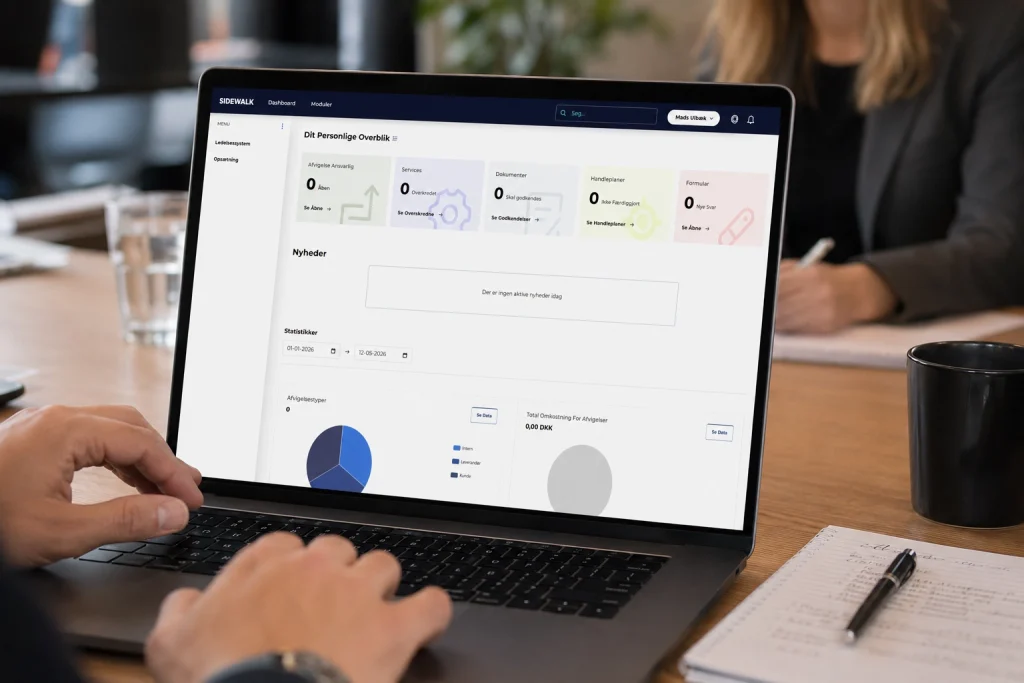
ISO 14001 is the international standard for environmental management and provides companies with a practical framework for managing, documenting, and improving their environmental performance.
The standard helps companies gain an overview of environmental impacts, legal requirements, risks, and opportunities—and translate them into concrete actions in their day-to-day operations.
MasterQMS can help consolidate these efforts into a digital management system where documentation, nonconformities, risks, audits, and follow-up are all managed in one place. They also offer advice and consulting services to help your company confidently move toward ISO 14001 certification.
ISO 14001 requires organizations to establish, maintain, and continuously improve an environmental management system. The purpose is to ensure a systematic approach to environmental management so that the organization can reduce its environmental impact, comply with legislation, and work purposefully toward improvements.
The organization must understand its context, relevant stakeholders, and the framework for the environmental management system. Management must take responsibility, establish an environmental policy, assign roles, and ensure the necessary resources are available.
The organization must identify significant environmental impacts from its activities, products, and services, and ensure an overview of relevant legal requirements and obligations.
ISO 14001 requires specific environmental objectives and plans to achieve them, as well as documentation that outlines processes, responsibilities, and results.
In its day-to-day operations, the organization must manage activities that impact the environment, suppliers, and emergency preparedness, and continuously evaluate and improve the system.
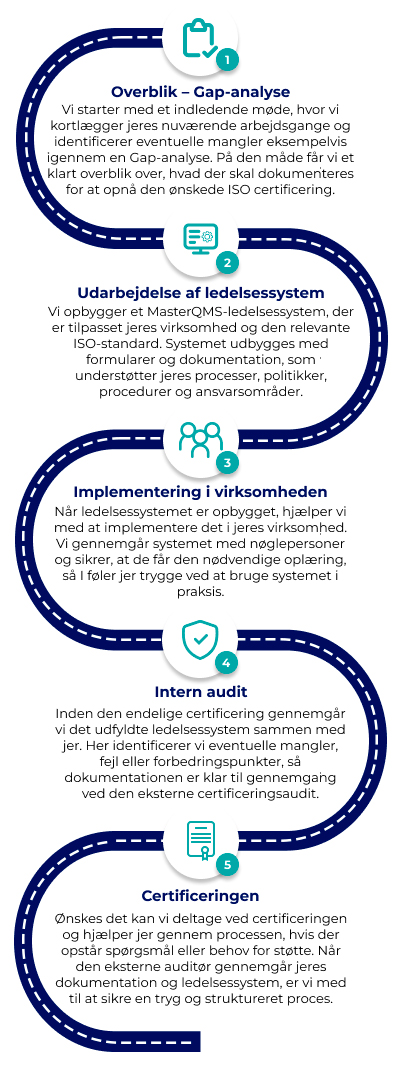
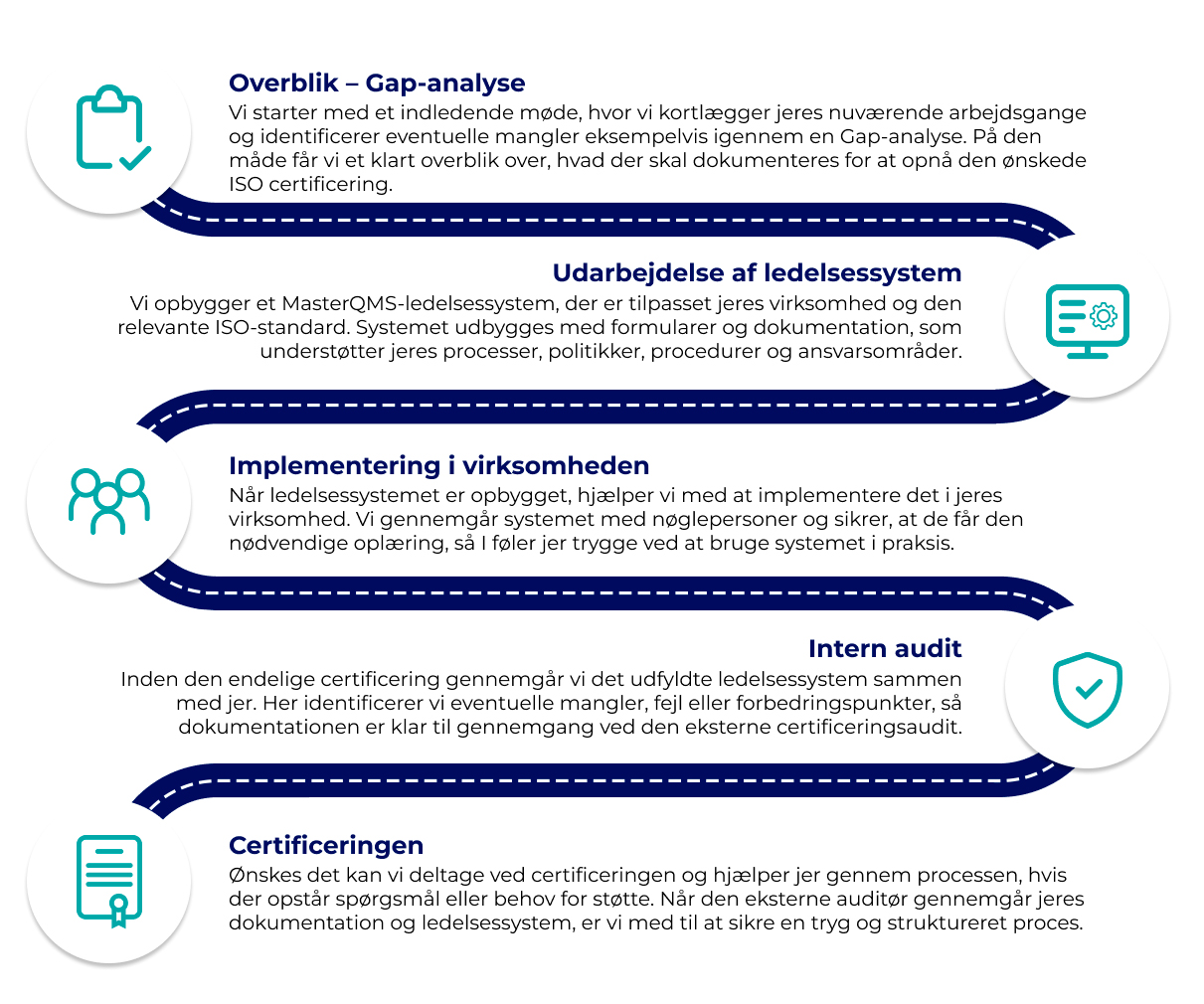
A simple and structured process from overview to a fully implemented system.
At MasterQMS, we offer flexible solutions so you can choose the approach that best suits your resources and needs:
Try our system FREE for 30 days and see how it can add value to your business.
All solutions are scalable and can be easily combined with other standards, such as ISO 9001.

The ISO 14001 standard plays a central role in companies’ ESG strategies (Environmental, Social, Governance). Environmental management contributes directly to the environmental aspect of ESG and can be documented effectively through a systematized management system.
The MasterQMS’ platform helps you set up and document environmental goals, carry out evaluations and improvements, and provide necessary documentation for ESG reporting.
Consulting within environmental management
If you’re looking to expand your current management system to include environmental management, or if you’d like to handle the implementation yourself but need guidance on ISO 14001, we have both the expertise and the skills to help you.
Regardless of whether you want help with the entire implementation or only need professional sparring, our experts are ready to advise you on:
Contact us today for a no-obligation conversation about how we can work together to strengthen your environmental efforts and secure ISO 14001 certification.
Environmental management is a structured approach to managing and reducing a company’s impact on the environment. It involves the company working systematically to identify its environmental impacts, set goals for improvement, and implement measures that reduce its environmental impact. Environmental management typically involves addressing resource consumption, waste management, energy use, emissions, and compliance with environmental regulations. The goal is to achieve continuous improvements in the company’s environmental performance.
Environmental management is important because it helps companies operate more responsibly and efficiently in relation to their environmental impact. By taking a systematic approach to environmental management, companies can reduce their resource consumption, minimize waste, and ensure better compliance with applicable environmental laws. At the same time, a strong environmental commitment can enhance the company’s reputation, build greater trust among customers and business partners, and contribute to more sustainable business development.
ISO 14001 is an international standard for environmental management that provides companies with a framework for establishing and operating an environmental management system. The standard outlines the requirements for how organizations can identify their environmental impacts, set environmental objectives, and work systematically toward continuous improvement. ISO 14001 can be used by organizations in all industries and of all sizes and is one of the most widely used standards in environmental management globally.
ISO 14001 certification is official recognition that a company meets the requirements of the ISO 14001 standard. The certification is issued by an independent certification body, which conducts an audit to assess whether the company’s environmental management system has been properly implemented and is functioning effectively. The certification serves as documentation for customers, regulatory authorities, and business partners that the company is systematically engaged in environmental management.
The cost of ISO 14001 certification depends on several factors, including the company’s size, the complexity of its organization, and how far along the company already is in its environmental management efforts. The costs may include the implementation of the environmental management system, any consulting services, employee training, and the certification audit itself. In addition, there will typically be ongoing costs for annual surveillance audits to maintain the certification.
To obtain ISO 14001 certification, the company must first establish and implement an environmental management system that meets the standard’s requirements. This involves, among other things, identifying the company’s environmental impacts, establishing an environmental policy, and setting goals for improvement. Once the system is implemented and functioning in practice, a certification body conducts an audit of the company. If the company meets the requirements of the standard, the certification is issued.
Being ISO 14001 certified means that the company has an environmental management system that meets international standards for environmental management. It demonstrates that the company works systematically to identify and reduce its environmental impact while complying with relevant legislation. The certification also documents that the company is continuously working to improve its environmental performance.
An ISO 14001 certification is typically valid for three years. During this period, regular follow-up audits are conducted to ensure that the organization continues to meet the requirements of the standard. When the certification period expires, the organization must undergo a new certification process to maintain its certification.
ISO 14001 is used by companies and organizations around the world and is one of the most widely adopted standards in environmental management. Hundreds of thousands of organizations across many different industries use the standard as a framework for their work on the environment and sustainability. The standard is used by small businesses, large international corporations, and public organizations alike.
A company applies for ISO 14001 certification by contacting an accredited certification body that can carry out the certification process. Before the application can be submitted, the company must have implemented an environmental management system that meets the requirements of ISO 14001. The certification body then conducts an audit to assess whether the system meets the standard’s requirements.
Implementing ISO 14001 can provide companies with a number of benefits. The standard establishes a structured approach to environmental management and helps companies reduce their environmental impact and resource consumption. At the same time, ISO 14001 certification can strengthen a company’s credibility with customers, business partners, and regulatory authorities. Many companies also find that the standard can contribute to better risk management, increased efficiency, and a stronger market position.
Are you ready to take the next step?
Fill out the form, and let’s talk about how our system can help your business thrive.
We demonstrate how our system creates value in your business — whether you want to implement certifications or document your processes to ensure effective governance.
Try our system FREE for 30 days and see how it can create value for your business.